
“Clinic chha, tara patient chhaina?”
You are not alone. I have walked into clinics in Chitwan and Kathmandu with excellent doctors, good equipment, and empty waiting rooms. Two streets away, a clinic with the same services has a queue out the door.
The difference is rarely the medicine. Usually it comes down to whether patients can find you online and whether they trust what they see when they do.
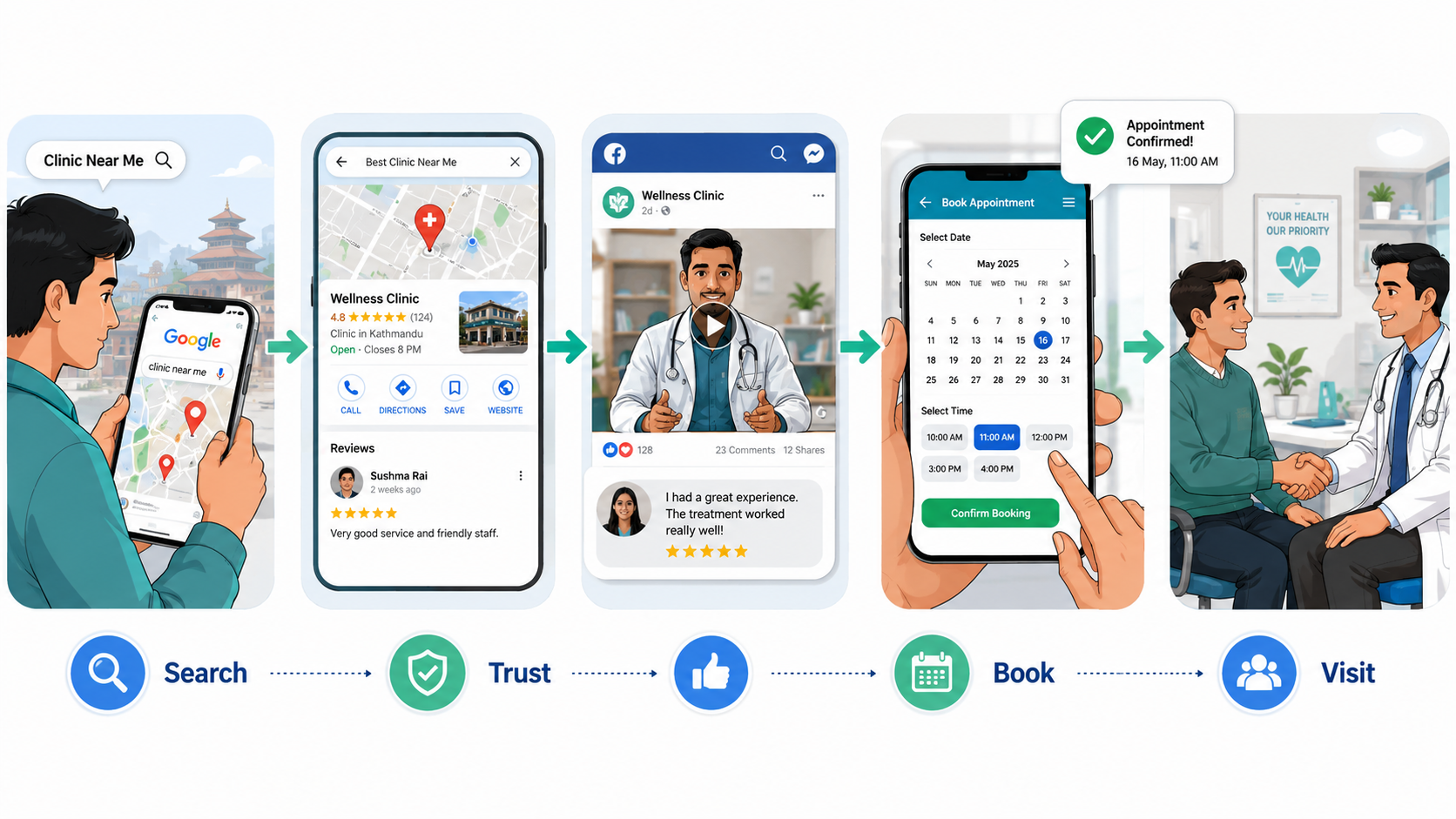
Most Nepali clinics still run on word of mouth. That worked in 2010. Today your patient’s first move is not asking a neighbor. It is typing “skin clinic near me” or “dentist Chitwan” into Google, then scrolling through Facebook to see if you look trustworthy. If you are invisible at those two moments, the patient books somewhere else before they ever hear your name.
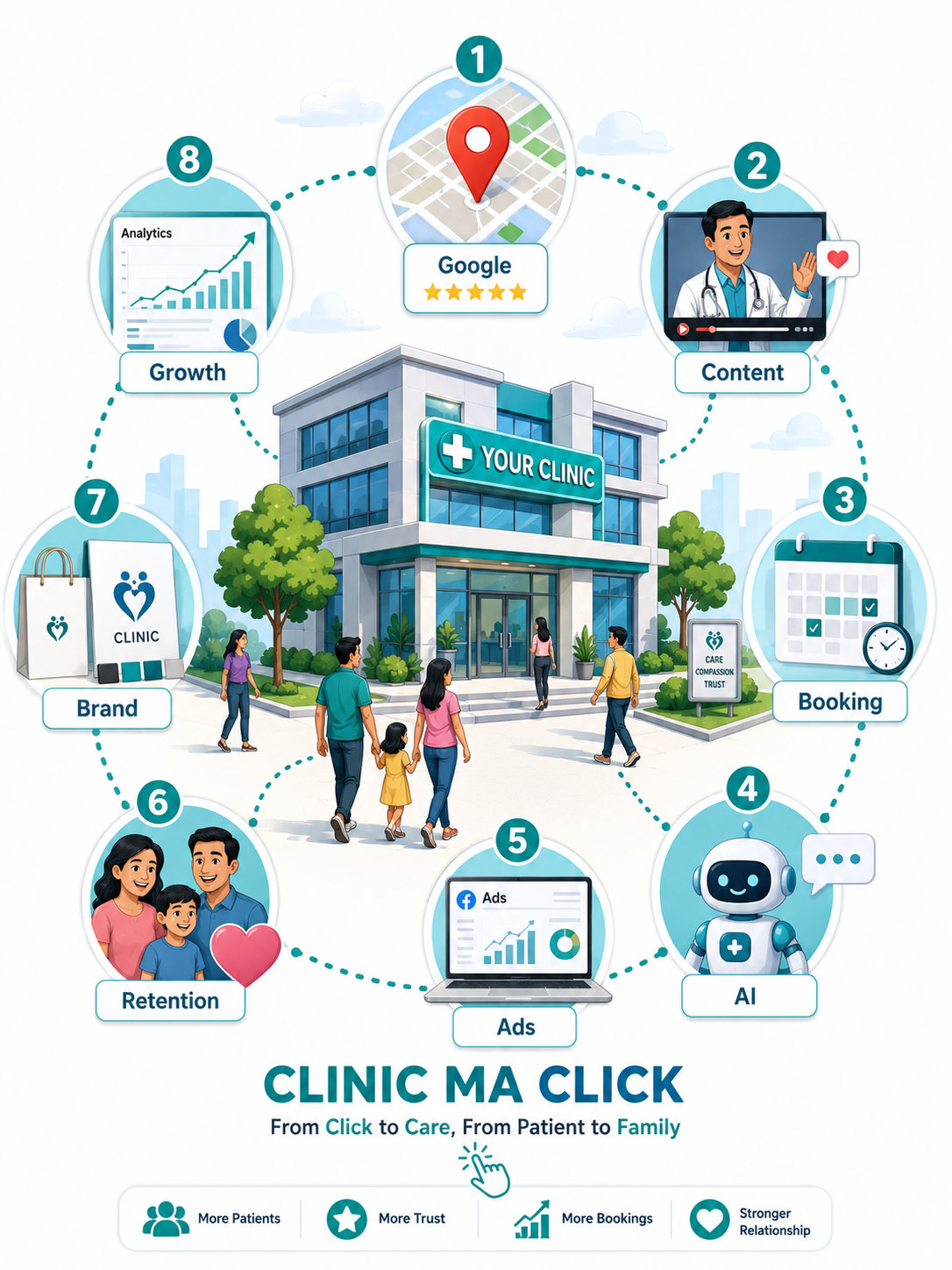
This article is the written version of my video series Clinic Ma Click by Digital Bikas. I have organized everything from the series into one roadmap, starting with free steps and building up to paid ads and automation.
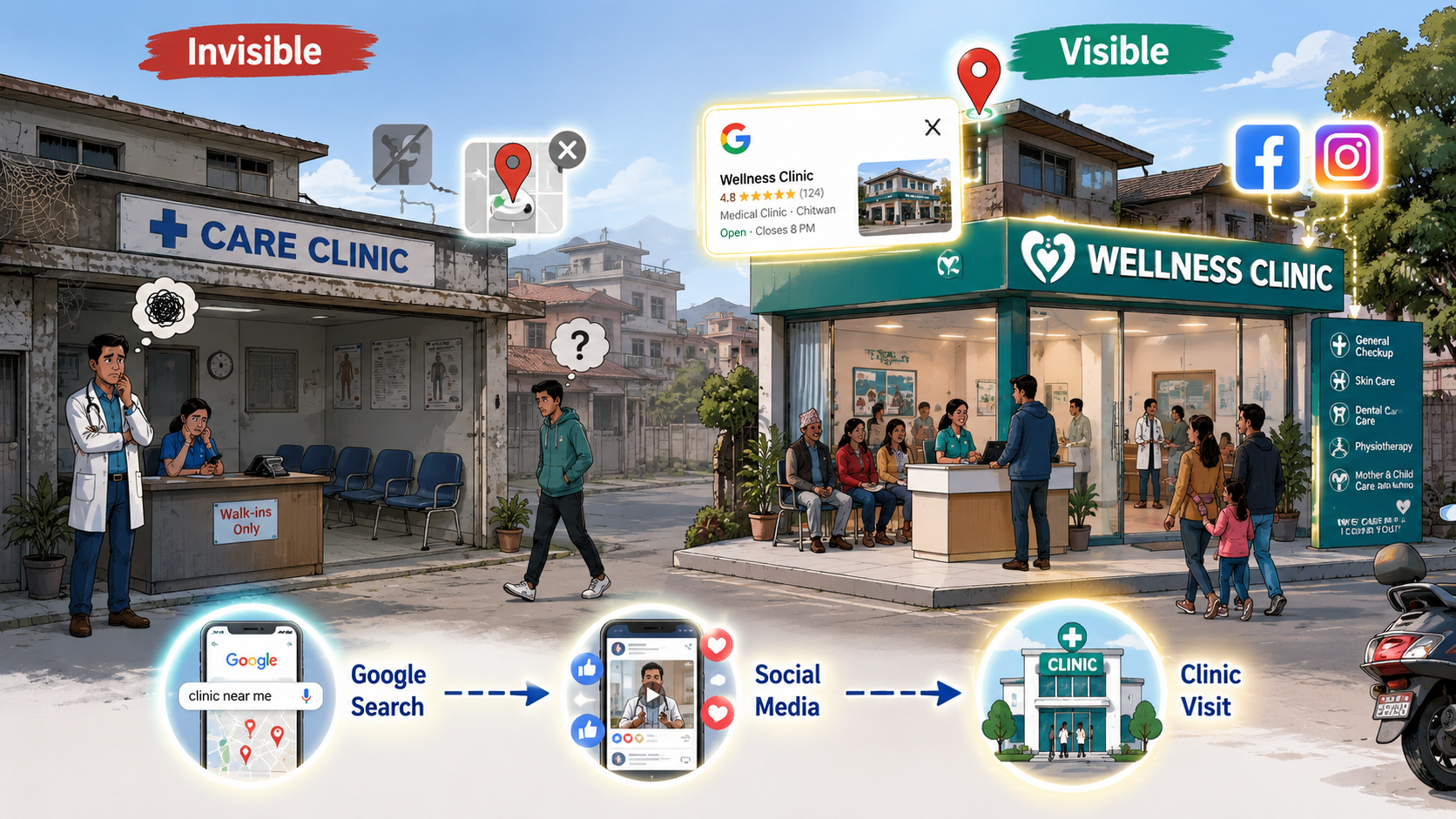
Why isn’t your clinic getting patients online?
Before fixing anything, be honest about where you stand. These are the problems I see again and again in Nepali clinics:
Your Facebook page exists, but the posts say nothing about your services, your super-specialities, or your offers. A patient scrolling past learns nothing.
Nepal now has almost as many clinics as momo pasals. When every clinic is named some variation of “Care” with a blue logo and a photo of a doctor in a white coat, patients cannot tell you apart, so they forget you.
Booking still happens on paper and a phone line that is always engaged. The patient calls, nobody picks up, they call the next clinic on the list.
There is no waiting time information, so patients sit for hours and quietly decide never to come back.
You run a free health camp, put up one poster two days before, and wonder why nobody showed up.
Meanwhile, your competitor is boosting posts every week. The question from the series still applies: tapaiko clinic le ke gardai cha ta?
If three or more of these sound familiar, keep reading. I have ordered the fixes from free and easy to paid and advanced.
Step 1: Claim your Google Business Profile (it’s free)
Around 80% of Nepali clinics ignore the single most powerful free tool available to them. When a patient searches “clinic near me” or your specialty plus your city, Google shows a map with three listings at the top. If your clinic is not on that map, that patient will never know you exist.
Setting up a Google Business Profile takes one afternoon:
- Go to google.com/business and claim or create your listing
- Fill in your exact address, opening hours, phone number, and services
- Upload real photos: your building, reception, consultation rooms, your doctors
- Verify the listing (Google usually sends a code)
Then maintain it. Upload new photos monthly and ask satisfied patients to leave a Google review before they walk out. Reviews decide most patients who are choosing between two unfamiliar clinics.
I have watched a clinic with 40 honest reviews win against a clinic with better doctors and zero reviews, simply because the second one looked like a ghost online.
Step 2: Post content that builds trust, not just posts
Most clinic pages post blurry photos with tiny text and, somehow, “kutuma kutu supari dana” song playing in the background. That content drives patients away instead of pulling them in.
Three content types consistently build patient trust:
- Doctor introduction videos. A one-minute clip where your doctor explains their experience, specialty, and who should visit them. Patients pick a doctor they feel they already know, not a building. A weekly “Meet Our Doctor” feature gives your clinic a face.
- Patient testimonials and before/after stories. Real transformations, told by real patients (with their written consent), do more for trust than any advertisement. A joint pain patient describing how they can climb stairs again is worth ten graphic-design posts.
- Educational health content. Short, useful answers to questions your patients already ask: “Garmi season ma ke garnu hunna?”, “Viral fever ma kahile hospital jane?”, “5 tips for healthy skin.” This shows your doctors’ expertise before the patient ever visits.
Add a monthly live Q&A session where patients ask questions directly, and you have a content system that runs on one to two hours per week.
For production, you do not need an agency. Canva covers post design and CapCut covers short reels; the substance comes from your doctors, and no tool can replace that part.
Follow the AIDA structure in every post: grab Attention with the first line, build Interest with a real problem, create Desire by showing the solution, and end with a clear Action like “Book your check-up this week.”
What about camera-shy doctors? The most common objection I hear. “I want to make content but I feel ashamed”
You can be out of the camera. Slideshows, B-roll footage of the clinic, voiceovers, and patient journey visuals work fine. Start with a simple clinic tour filmed on your phone, or a testimonial where the patient does the talking. Patients respond to authenticity, not production value.
The only rule that matters here is consistency: one video a week, every week, beats five videos once and then silence.
Step 3: Fix your booking system
Let me tell you about Radha aunty from episode 4. She has asthma. She phoned the clinic; the line was engaged. She went in person; the staff were busy and she waited three hours to see the doctor. That clinic did nothing medically wrong, and it still lost her loyalty forever.
If she could have booked online from home and received an SMS confirmation, she would have arrived at her slot time, gotten her medicine, and told her whole tole about the experience.
You do not need expensive software. Free and cheap options include:
- A Google Form linked from your Facebook page and Google listing
- Calendly for time-slot booking
- Automatic SMS confirmation (local providers offer this cheaply)
Will every patient book online? No, and that is fine. Keep the phone line and walk-ins. But the growing group of patients who prefer online booking needs a system waiting for them, and right now that system probably belongs to your competitor.
Step 4: Respond instantly with an AI chatbot
Here is a message I saw on a real clinic page: “Tapai ko clinic kaha chha?” The reply came two days later. The patient had already booked elsewhere.
Facebook inquiries are patients raising their hand. Every hour of delay costs you bookings.
An AI chatbot integrated into Messenger can handle the repetitive questions 24/7: opening hours, doctor schedules, treatment costs, the appointment process, directions. Your staff stay free for the work that genuinely needs a human.
Setup is cheaper than most owners assume, and basic versions can be built free with tools like Dialogflow. If you want to see one working, message my own chatbot Kanxa on the Digital Bikas page.
Step 5: Stop boosting, start advertising
Almost every clinic owner I meet has pressed the blue “Boost Post” button, spent Rs 2,000 to 5,000, and gotten nothing. Then they conclude that Facebook ads don’t work for clinics.
Facebook ads work fine. Pressing boost on a random post is what does not work, and it fails for predictable reasons:
- No real offer behind the post, just a generic photo
- Wrong campaign objective (boosting for likes instead of running a lead generation campaign)
- No geo-targeting, so your Chitwan clinic ad reaches people in Jhapa
- No age, demographic, or behaviour targeting
- No tracking, so you cannot tell what worked
- Weak creative: no hook, no clear call to action
The fix is running proper campaigns in Meta Ads Manager instead of boosting. Target a 10 km radius around your clinic. Match age and demographics to your speciality (a joint pain campaign targets 40+, a skin clinic targets 18 to 35).
Use lead forms so interested patients leave their name and number. Track cost per lead, not likes.
A real example from episode 5: a skin clinic offered a free skin analysis through a simple Facebook form. Patients filled it in, the clinic replied with personalized feedback, and bookings doubled.
A genuine free offer plus proper targeting beats a boosted “10% discount” post every time. You also collect patient details you can follow up with later, which brings us to retention.
Step 6: Turn first visits into loyal patients
New patient acquisition gets all the attention, but repeat patients are where a clinic’s steady income lives. Most Nepali clinics run a “visit garyo, ani bhule” model:
- Appointment follow-up? Chhaina.
- Next visit reminder? Chhaina.
- A simple birthday message? Chhaina.
Then the owner stands in an empty clinic wondering, “kaha gaye mero regular patients?” They are at the clinic across the road, which also did nothing special, but was at least visible when the patient needed care again.
A basic retention system needs three things:
- First, store patient data properly, in a simple CRM or even a well-organised Google Sheet with name, phone, visit date, and condition.
- Second, automate follow-ups: auto SMS reminders for next visits and check-ups cost very little and feel very professional.
- Third, add a personal touch. “Thank you for visiting” after the appointment. Hope you’re feeling better” two days later. These messages take seconds and are almost never sent, which is exactly why they stand out.
Also ask patients directly to follow your social pages, and give them a reason: health tips, seasonal advice, or occasional follower-only offers.
An engaged follower sees your clinic in their feed every week, and that kind of steady visibility is hard to buy with ads.
Step 7: Build a brand patients remember
Ram compares choosing a clinic in Chitwan to scrolling Netflix: twenty options, all named “Care,” all with blue logos and doctors in white coats – total confusion.
When everything looks the same, patients effectively pick by lucky draw. You do not want your clinic’s future decided by a lucky draw.
Patients rarely remember clinic names. They remember colors, feelings, and the doctor’s manner. As I put it in the series, branding is a mental bookmark.
Three things to start this month:
- A signature color palette : Pick one distinctive combination (teal and white, orange and navy, or whatever fits) and use it everywhere: walls, posts, signboard, and even the trim on the doctor’s coat.
- A short slogan: Something like “Family Health with Heart” or a local positioning line like “Chitwan ko #1 Joint Pain Specialist.” Put it on the reception board and every post.
- Consistency across channels: Same fonts, same tone, same feel on Facebook, Instagram, and your hoarding board. People need to see the same look several times before it sticks in memory.
Here is the part small clinics get wrong: they assume branding needs a corporate budget. It does not. Branding is consistent messaging plus emotional connection, and both are nearly free.
Patients remember how you made them feel long before they remember your clinic’s size.
Philip Kotler’s 5A framework describes the journey you are designing for: the patient becomes Aware of you, feels Appeal, starts to Ask and compare, decides to Act and book, and finally becomes an Advocate who recommends you to others.
Every branding decision should move patients one step along that path.
If done right, the shift is visible in how patients talk. They stop saying “tyo clinic” and start saying “mero clinic.”
Step 8: Use your own data (and promote camps properly)
Two advanced moves once the basics are running.
- Seasonal, data-driven campaigns.
Your appointment records already show when patient flow peaks.
If dengue cases spike every year in the same months, run a “Dengue Awareness + Discount on Checkup” campaign before the season starts, with scheduled posts and SMS reminders.
Clinics that do this have appointment queues before the season even begins. Guess nagari, data le guide garnus.
- Health camp promotion.
Free camps fail for one reason: promotion starts two days early with one poster and an FM announcement.
FM sune nasuneko thaha hudaina, and the pamphlets end up wrapping sel roti at the chapat pasal.
Announce camps at least 10 days ahead. Run a boosted Facebook event with tight location targeting. Add an SMS blast to your existing patient list.
A full camp does more for your clinic’s branding than any ad, because attendees experience your care firsthand.
The advantage of digital – over FM and pamphlets is measurement. You can see exactly how many people saw your content, engaged, clicked, and booked, so every rupee you spend is accountable.
Your 30-day clinic marketing checklist
- Week 1: Set up and verify your Google Business Profile; upload photos; ask your first five patients for reviews
- Week 2: Film one doctor introduction video and one patient testimonial on your phone; post both
- Week 3: Create a Google Form or Calendly booking link; add it to your page, listing, and post captions; set up auto SMS confirmations
- Week 4: Launch one small geo-targeted lead campaign (not a boost) with a genuine free offer; start your patient follow-up sheet.
You can do all of this on a small budget. The harder part is accepting that word of mouth alone stopped being enough a few years ago.
Frequently asked questions
- How much should a small clinic in Nepal spend on digital marketing?
– Start with zero: Google Business Profile, organic content, and a free booking form cost nothing but time. Once those work, Rs 5,000 to 15,000 per month on properly targeted Meta ads is enough for most single-location clinics to see measurable bookings. - Is Facebook or Google more important for clinics?
– Both, for different jobs. Google captures patients searching for care right now. Facebook builds trust and recall before they need you. Google Business Profile comes first because it is free and captures high-intent patients. - Do doctors really need to appear on video?
– No. Voiceovers, slideshows, clinic tours, and patient testimonials work without the doctor facing the camera. Consistency matters far more than confidence on camera. - How long before results show?
– Google reviews and listing improvements often show within weeks. Establishing credibility with content takes two to three months of consistent posting. Paid campaigns can produce leads in days if the offer and targeting are appropriate.
Now, if you’re a clinic owner or doctor looking to increase patient flow through content marketing, ads, video editing, and lead generation, schedule a free digital consultation here  : marketing.digitalbikas.com.